
Flipping France's Migration Narrative On Its Head
A new exhibit at the Musée de l'Homme takes the long view on the phenomenon of migration to France.

In June 1940, when Nazi tanks rolled into Paris, a young curator tacked a poem to the entrance of his museum. In “If,” written by Rudyard Kipling in 1895, the poet exhorts:
“If you can keep your head when all about you / Are losing theirs and blaming it on you … Yours is the Earth and everything that’s in it.”
That courageous curator — Paul Rivet — would go on to the join the French Resistance. His museum still exists to this day. And true to form, the institution hasn’t lost its seditious edge.
In an era when the topic of migration has been weaponized by right-wing media, talking heads and politicians, in France as in the United States and elsewhere, “Migrations, a Human Odyssey,” the new temporary exhibit at the Musée de l’homme in Paris flips this narrative upside down. The exhibit opened in late November, but will be up until June 8, 2025, meaning residents and visitors still have ample time to check it out.
I made my way to the Musée de l’homme on a rainy Saturday in late December. The museum entrance is located just outside of the Trocadéro metro station on the number 9 line, which means that you barely have to step a foot outside in the Paris rain before ducking into the museum.
Today’s museum takes up one wing of the original Trocadéro palace, constructed as part of the same World’s Fair that brought the Eiffel Tower to Paris in 1878. This space, initially converted into an ethnography museum, was rebaptized the Musée de l’homme, or “Museum of man” in 1937 — during a political climate, as the museum writes on its website, “marked by the upheavals of the Front Populaire, the exacerbation of nationalism and signs of the rise of fascism.” (Sounds familiar!)
Rivet, speaking the following year, explained his decision to rename the museum:
“In creating this title, I wanted to indicate that everything concerning the human being, in its multiple aspects, should and could find a place in the collections. (...) It was necessary to bring together in a vast synthesis all the results acquired by specialists, forcing them to compare their conclusions, to check them and to support one another. Humanity is an indivisible whole, not only in space, but also in time.”
The idea of time travel is still tangible in the museum. Before making my way to the temporary exhibit on the second floor, I checked out the permanent collection. Weaving between young children on some sort of a field trip, I perused the various artifacts which include a mummy, the skull of philosopher René Descartes and a modern day Senegalese bus that was airlifted to Paris.
The bus, a car rapide, had been decorated with colorful slogans and contrasted with the perennial gray of Paris in winter.


Located upstairs, the temporary migration exhibit complements and continues the permanent collection. Although not necessarily conceived of in the form of a protest, the exhibit’s contextualization and reframing of the phenomenon of migration feels contentious given the current identity politics at play in France and around the world.
As the curators explain:
“Migration is a constant and regular phenomenon that is inseparable from the history of humanity. Its particularity is not so much its size as the large variety of faces, routes, reasons and experiences of those whom we call migrants.
Today, as in the past, human beings ensure their survival through movement, intermingling and both biological and cultural contributions. This reality is opposed to fantasies of pure origins and the separation of groups of humans.”
As any good educational experience does, the exhibit spends a significant amount of time on definitions. Though I’ve studied the phenomenon, it was nice to get a refresher on the origins and subtleties of terms like migrant, emigrant, refugee, asylum-seeker and expat.
I appreciated, too, that the French words were juxtaposed with the terms used in other languages, including Wolof (spoken in Senegal) and Arabic. In North African Arabic, for example, many migrants are called “harrag,” a word that literally comes from the verb “to burn.” These migrants — burning bridges with their past and starting anew — undertook the arduous and dangerous journey across the Mediterranean, a phenomenon I discussed with Algerian-French journalist Nejma Brahim in a recent conversation for this Substack.
Moving along the exhibit, we hear from some of these migrants in interviews with the team of museum curators. I sat down to listen to the story of a Malian teen who had crossed the Libyan desert and the Meditarranean before landing in the French capital, a story I’ve become familiar with while reporting on the displacement engendered by the 2024 Paris Olympics. After crossing all of these borders, he ended up sleeping rough in the streets and train stations before a woman pointed him in the direction of a charity association that took up his case. His steely resolve in the face of a seemingly impossible situation reminded me of so many young men and women I’ve spoken with and who have opened up to me about their migratory journeys.
Throughout the exhibit, videos and other multimedia reframe the conversation on migration. Contrary to the myth of the “invasion” of migrants in France, we also learn that in the past two and a half decades, the number of immigrants residing in France has not significantly increased — moving from 7 percent in 1999 to 11 percent today. Far from the deluge decried by much of the French political sphere.
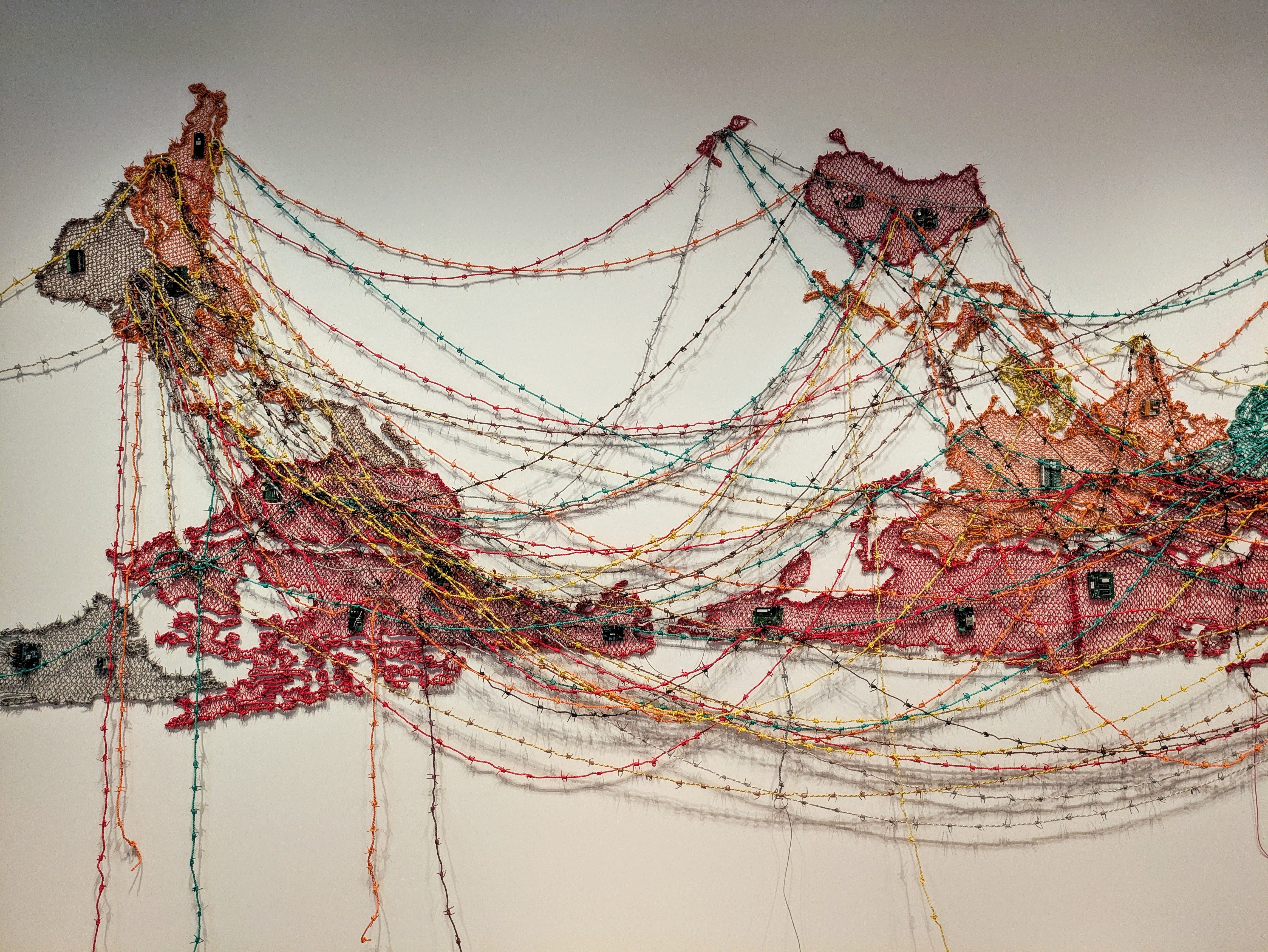
But for me, perhaps the most cogent storytelling was the picture at the top of this post. We tend to think of migration as one going in one direction: south to north. What happens when you flip that narrative?
I recommend this exhibit, and I’d also recommend thinking about what that might look like.
No one looks at the actual numbers, much less any accounting of the North’s predation on the South amidst the clutching of pearls about migrant surges
Very well written and informative